This is the companion to my ADHD brain post. And I’ll confess something up front: I’m not entirely sure which parts of me are the autism.
For my book, I built a table. ADHD tendency in one column, autism tendency in the next, then what the clinician sees, and what’s actually happening. I call it the cancellation effect. Two conditions stacked on top of each other, hiding each other’s symptoms, until the doctor sees nothing at all.
But when I looked at that autism column, I couldn’t tell you with confidence where the autism ends and the ADHD begins. From the inside, it’s one brain. It doesn’t come with labels.
Turns out, scientists can’t untangle it either. Somewhere between 30 and 40 percent of autistic people also have ADHD, and the two share a big chunk of their genetics. Yet when researchers compared brain scans from thousands of autistic people and people with ADHD, they found no shared structural signature. Until 2013, you officially couldn’t be diagnosed with both. Guess how many of us got neither.
The Parts I Can Name
Some of it, I can sort.
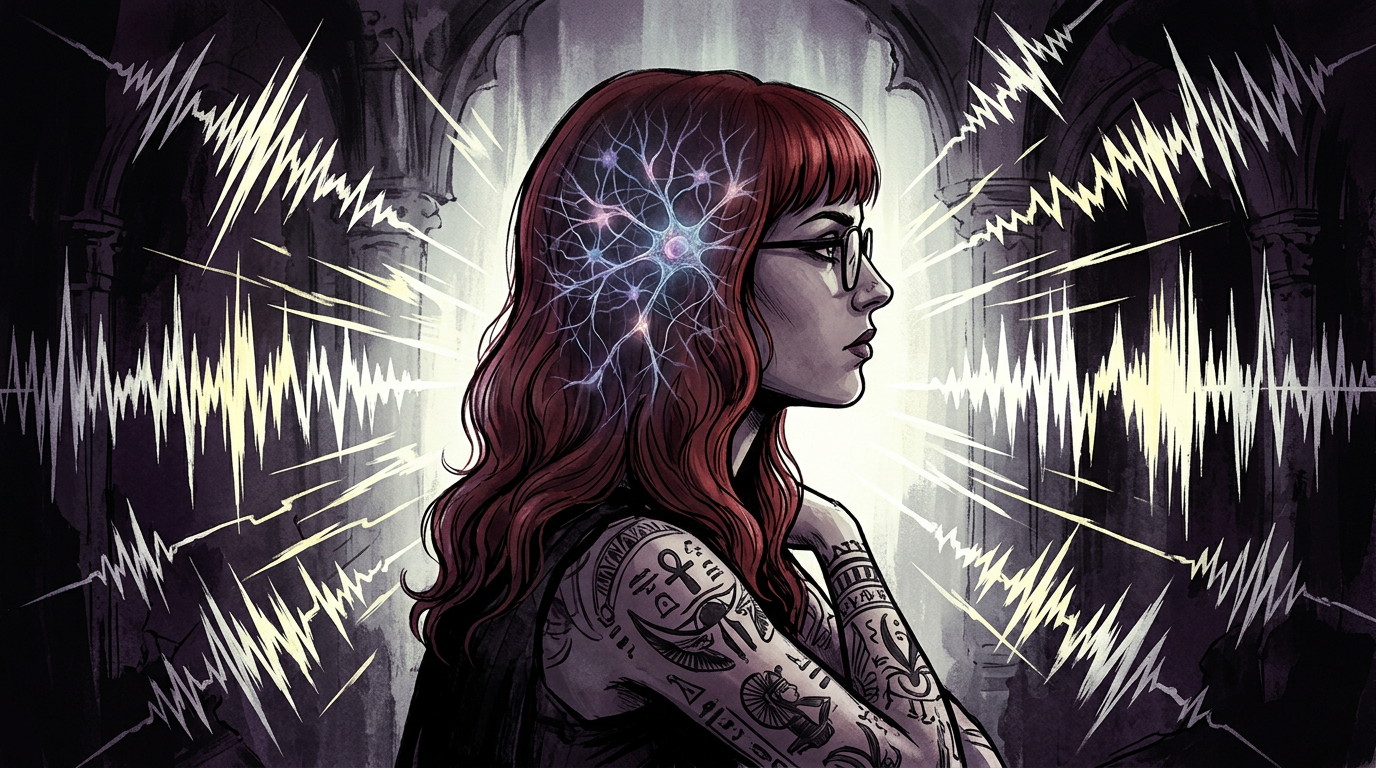
My outside is pure ADHD. Tattoos. Red hair. A nose piercing. Mostly black clothes. My hair has been pink, black, blue, purple, and whatever else I felt like that month. I’ve lived in four countries, and moving never scared me. I look wild, and the wild fits the spontaneity. The ADHD gets bored fast, needs novelty, and has no impulse control. It’s the part that decides on a Tuesday to take the rest of the week off and fly to Hawaii.
But people who see me as the wild one are always a little disappointed by the inside. The inside is, frankly, boring. I don’t break rules, unless they’re utterly useless. My home is always clean and organized. I hate being the center of attention. I have very clear rules about right and wrong, and a sense of justice that does not switch off.
That’s the autism. It demands protocol. Rituals. Routines. And they aren’t optional. Without them, I forget things, get disorganized, and get overwhelmed fast.
For most of my life, that split made me feel like I had a dark side. The rule follower was the real me. The ADHD was the dark side, the one buying plane tickets.
Now I see it differently. Neither one is the dark side. They’re two operating systems on the same hardware, and they don’t always agree on the plan. One wants Hawaii. The other wants to know exactly when the flight lands.
The Volume Knob
The worst part of autism, for me, is sensory overload. Bright light. Loud noise, especially high-pitched. Children screaming. High singing voices. Strong smells. Wool on my skin. Anything tight around my neck.
Then there’s food. No warm fruit. Ever. No pineapple on pizza. No fruit in my cream of wheat as a kid. Nothing soggy. And the sauce does not touch the mashed potatoes.
The science offers a few clues. During childhood, every brain builds more connections than it needs, then prunes them back. One study found typical brains cut about half. Autistic brains cut about 16 percent. More connections, more input. Not less brain. More.
A leading theory adds that the autistic brain leans less on predictions and takes in more of what’s actually there. A typical brain has seen a thousand rooms, so it fills in the details for you. Mine processes every sound, light, and texture fresh. The evidence is still mixed, but from the inside, it fits. It also explains my rituals. Order isn’t fussiness. When the world comes in that loud, order turns the volume down.
The Body That Doesn’t Report In
Here’s where it gets weird. The same brain that can’t handle a screaming child on a train barely noticed when my appendix burst.
I was a teenager. I had bad abdominal pain for a couple of days and didn’t think much of it, until I literally had to lie down. By the time my mother got me to the hospital, I was three hours from death.
Years later, I walked around with a torn rotator cuff for more than a year, until I had lost all range of motion in my left arm. And my whole life, I’ve found huge bruises with no idea where or when I got them.
So I must have a superhuman pain tolerance, right? Even the diagnostic manual lists “apparent indifference to pain” as an autistic trait.
Apparent. That word is doing a lot of work.
The idea that autistic people don’t feel pain is mostly a myth. In one study, autistic kids barely reacted to a blood draw on the outside, while their heart rates jumped more than the other kids’ did. They felt it. It just didn’t show.
The pain arrives. It just doesn’t get flagged. That’s interoception, the brain’s ability to read signals from inside the body. It’s closely tied to alexithymia, difficulty identifying your own feelings, which affects about half of autistic people, compared to around 5 percent of everyone else.
Add my freakishly bendy joints. Hypermobility is far more common in neurodivergent people, and bendy joints are less stable and send blurrier signals about where your body is. Hello, rotator cuff. Hypermobility also links to chronic pain like my fibromyalgia.
Which leaves a paradox. How does one body amplify pain until everything hurts, and still miss a burst appendix? My theory, not science: in fraud prevention, the hardest signal to catch is the one buried in noise. If everything hurts a little all the time, a new pain doesn’t stand out.
So when a doctor asks me to rate my pain, I say 4. For anyone else, it’s probably an 8. And nothing gets diagnosed.
The Empathy Myth
Autistic people lack empathy. You’ve heard it.
I scored 100 percent on an Ekman emotion recognition test. Not because I’m a natural. Because as a kid, my survival depended on reading people exactly right. And I don’t just read other people’s emotions. I feel them, physically.
The science is catching up. In one brain study, the empathy difference between autistic and non-autistic people disappeared once researchers accounted for alexithymia. Figuring out what someone thinks and feeling for them are two different systems, and the feeling part is usually intact. Communication between autistic and non-autistic people breaks down in both directions. Funny how nobody accuses the non-autistic person of lacking empathy for not understanding us.
Where It Knots Back Together
At home, the sauce doesn’t touch the mashed potatoes, and then I mash everything into a pulp before I eat it. In a restaurant, I eat like everyone else. Nobody watching would ever guess.
That’s the cancellation effect in a single dinner. People see the tattoos and the hair, assume chaos, and never look for the autism. ADHD hides some of the autism. Autism hides some of the ADHD. Masking hides the rest.
So I can name a few parts. The rest, I still can’t untangle. Neither can the scanners. I’ve made my peace with that.
The autistic brain isn’t broken. It kept more of its connections. The outside comes in too loud. The inside comes in too quiet. That’s not a defect. It’s a different calibration.
The world was turned up too loud, my body was turned down too quiet, and somewhere in the middle, I learned to look completely normal. That’s not the absence of autism. That’s what it looks like when nobody knows where to look.
This post is my lived experience plus research, not medical advice. If any of it sounds familiar, talk to a clinician who knows how autism shows up in adults, especially women.